See PDF below for a comprehensive study of this lot.
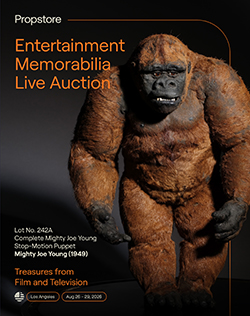
Bidding for this lot will end on Wednesday, August 26th. The auction will begin at 9:30 AM (PDT) / 12:30 PM (EDT) / 5:30 PM (GMT) and lots are sold sequentially via live auctioneer; tune in to the live streaming broadcast on auction day to follow the pace. Note other lots in the auction may close on Thursday, August 27th or Friday, August 28th or Saturday, August 29th.
Overview
A complete original 15-inch stop-motion animation puppet of Mighty Joe Young, believed to be the only fully intact puppet surviving from the landmark 1949 film. The model retains the vast majority of its original latex skin and fur covering, which remains intact and stable after more than seventy-five years, while its complete original internal stop-motion armature survives beneath the skin, as confirmed through recent X-ray examination. Few production puppets of this era have endured in such a remarkable state of preservation.
Among surviving artifacts from the golden age of stop-motion animation, few possess comparable historical importance. Mighty Joe Young represented the culmination of Willis O'Brien's pioneering work in realistic creature animation. Widely regarded as the spiritual successor to King Kong (1933), the film advanced the art of stop-motion through more sophisticated animation, engineering, and performance. It also marked the emergence of Ray Harryhausen, O'Brien's protege, who was only twenty-seven years old during production. It remains the only completed feature film on which O'Brien and Harryhausen collaborated.
The puppet remained in the same private collection for approximately fifty years and is now offered publicly for the first time. It has had only three known owners, the first being Mighty Joe Young’s co-producer and co-director Ernest B. Schoedsack.
Its most recent owner was legendary visual effects artist and puppeteer Lyle Conway, who acquired it in the late 1970s from an individual who had obtained it directly from Schoedsack during the 1950s. Conway treasured the puppet as one of the centerpieces of his collection, and it has rarely been seen during the past half century.
As the only complete Mighty Joe Young animation puppet known to survive, this is one of the finest and most historically important stop-motion artifacts ever to come to public auction.
Included with the puppet are a copy of a letter from Ernest B. Schoedsack concerning the puppet, dating to circa 1957; an original letter from Mrs. W. H. O'Brien to Lyle Conway, dating to circa 1972; a series of ten black-and-white photographs of the puppet taken during the 1960s or early 1970s; and nine original black-and-white production photographs from Mighty Joe Young.
Dimensions (as posed): 13.5" x 10" x 7.5" (34.5 cm x 25.5 cm x 19 cm)
The Puppet
This model is one of only four primary stop-motion animation puppets constructed for Mighty Joe Young and is believed to be the best surviving example—the only model known to retain its original armature, latex skin, and fur covering. The other known surviving elements consist of one puppet skin, in poorer condition than this example, and two skinless armatures. One of the armatures is believed to have originally belonged to the surviving skin before the two were separated. The fourth principal puppet has never been located.
The puppet survives in an exceptionally complete state, retaining the vast majority of its original latex skin and fur covering. Although the latex has naturally dried with age, it remains intact without evidence of significant instability and retains slight flexibility in certain areas. Comparison with photographs taken during the 1960s and 1970s indicates that limited restoration was carried out to portions of the face and hands at some point thereafter, while preserving the overwhelming majority of the puppet's original materials. Those same photographs also show that the puppet has remained in the same pose since that time. Although the original internal armature remains intact, the drying of the latex prevents any adjustment to the pose. Such preservation is exceptionally rare among surviving stop-motion puppets, whose latex coverings have typically deteriorated extensively. By comparison, the other known surviving Mighty Joe Young puppets, as well as the surviving King Kong puppets, consist only of exposed armatures or retain only fragmentary portions of their original skin coverings.
Lessons learned during production of King Kong led to significant improvements in puppet construction for Mighty Joe Young. Earlier puppets often displayed unintended movement of the fur during animation due to repeated handling. The fur application techniques developed for Mighty Joe Young greatly reduced this "boiling" effect, producing a more convincing illusion of living fur on screen. Beneath the skin, the puppet retains its original articulated metal armature, the precision mechanism that made its stop-motion performance possible.
Visible seam lines at both shoulders appear to indicate that the latex skin was opened during production to provide access for maintenance of the internal armature. Similar shoulder seams are visible on Joe in several shots within the finished film, suggesting that this was a normal part of the working life of the animation puppet rather than later damage.
Accompanying the puppet is its original glass display bell, which has remained with the model since at least the 1950s, further documenting its long history of preservation.
The Armature
At the heart of the puppet is an exceptionally sophisticated articulated armature, among the most advanced stop-motion mechanisms constructed anywhere in the world at the time. Constructed by master model maker Marcel Delgado and his team under the direction of Willis O'Brien, the armature incorporates steel, brass, aluminum, and Bakelite components into a complete mechanical skeleton.
The armature provides articulated movement throughout the body, extending to the fingers, toes, eyebrows, nose, lips, and jaw, allowing animators to create remarkably subtle and expressive performances. Such precision was revolutionary in an era when convincing fantasy creatures had never before appeared on screen. O'Brien's engineering enabled audiences to believe, for the first time, that an impossible creature could possess convincing weight, personality, and emotion.
One noteworthy feature of the armature is its shoulder construction. Unlike the other known surviving Mighty Joe Young armatures, which utilize a hinge-and-swivel shoulder assembly, this example employs true ball-and-socket joints. Ball-and-socket joints provide a considerably greater range of movement and allow smoother, more natural positioning of the arms during animation.
Ray Harryhausen later recalled preferring this style of shoulder joint and requesting it for certain Mighty Joe Young puppets during production. Harryhausen nicknamed his favorite animation puppet "Jennifer," after actress Jennifer Jones. Because "Jennifer" was described as having ball-and-socket shoulders—and this is the only known surviving Mighty Joe Young puppet with that feature—it is possible that this specific puppet is Harryhausen's "Jennifer," although this cannot presently be proven.
The jaw is operated by a screw that remains visible today on the underside of the lower jaw, immediately behind the chin. By turning this screw, the animator could position the mouth precisely without the elasticity of the latex pulling it closed. This ingenious mechanism provided a level of control over facial performance that had rarely, if ever, been achieved in stop-motion animation to that point.
Recent X-ray examination confirms that the original internal armature survives complete and intact beneath the skin. The imaging revealed no evidence of missing or replacement structural components, making this the single remaining Mighty Joe Young puppet with its complete original mechanical structure beneath its original skin.
The Puppet's History
The puppet has had only three known owners since its creation for Mighty Joe Young in 1948.
Following production, it passed into the ownership of the film's co-producer and co-director, Ernest B. Schoedsack. During the 1950s, Schoedsack transferred the puppet to early film memorabilia collector Clark Wilkinson of Wisconsin, both men believing at the time that it had been used in King Kong—an understandable assumption given the close relationship between the two productions and the similarity of their animation puppets. Wilkinson displayed the puppet as one of the highlights of a small private movie museum maintained at his home. Period photographs documenting the puppet in Wilkinson's collection survive and provide an invaluable record of its appearance during the mid-twentieth century.
Circa the late 1970s, Wilkinson sold the puppet to visual effects artist and puppeteer Lyle Conway. Conway, whose own work influenced generations of creature designers and practical effects artists, regarded Mighty Joe Young as a formative inspiration and considered the puppet one of the centerpieces of his collection.
A notably private individual, Conway rarely exhibited or discussed the puppet during his nearly fifty years of ownership, and few collectors or historians had the opportunity to examine it firsthand. The puppet is being offered at public auction for the first time in its history.
The Legacy of Mighty Joe Young
When Willis O'Brien began bringing prehistoric animals and giant fantasy creatures to life through stop-motion animation during the 1920s and 1930s, audiences had never witnessed anything comparable. Decades before the advent of computer-generated imagery, O'Brien developed techniques that created the convincing illusion of living creatures sharing the screen with human actors. His work fundamentally changed what audiences believed motion pictures were capable of showing. For the first time, impossible creatures appeared to possess convincing weight, personality, and emotion, forever expanding the boundaries of cinematic storytelling. Released in 1949, Mighty Joe Young represented the culmination of O'Brien's pioneering career. A follow-up to the landmark King Kong, it reunited producer Merian C. Cooper, director Ernest B. Schoedsack, and O'Brien to refine the revolutionary techniques they had introduced sixteen years earlier. The film earned the Academy Award for Best Special Effects, the only competitive Oscar awarded to O'Brien during his lifetime.
The production also marked the emergence of Ray Harryhausen, who, under O'Brien's mentorship, animated much of Joe's on-screen performance. His career was only beginning, and Harryhausen went on to become one of the world's most celebrated stop-motion animators. Harryhausen carried O'Brien's innovations forward in films including The 7th Voyage of Sinbad, Jason and the Argonauts, and Clash of the Titans, inspiring filmmakers and artists who came after him around the world. As the film where O'Brien passed the stop-motion torch to Harryhausen, Mighty Joe Young occupies a unique place in the history of cinematic visual effects, capturing the moment one generation of pioneers passed the art to the next.
An Extraordinary Opportunity
Original stop-motion animation puppets are among the rarest surviving artifacts from the formative years of cinematic visual effects. Unlike most film props, these models were themselves the performers—every movement, gesture, and expression was created by manipulating the puppet thousands of times, one frame at a time. They embody not only the craftsmanship of their makers, but the performances themselves.
At a time when audiences had never witnessed believable fantasy creatures on screen, these handcrafted puppets made the impossible appear real. They transformed fantasy from illustration into living cinema and established the artistic and technical foundations upon which generations of visual effects artists would build.
Just as an original Walt Disney drawing of Mickey Mouse represents the birth of character animation, or an original Star Wars filming miniature embodies the revolution in modern visual effects, an original Mighty Joe Young animation puppet is a tangible link to one of the foundational achievements in the history of cinema. It is simultaneously a production tool, a work of sculpture, and the physical instrument through which one of the most celebrated stop-motion performances ever created was brought to life.
Its exceptional historical importance is matched by an equally extraordinary degree of physical preservation. As the last remaining complete Mighty Joe Young puppet—retaining its original armature, the vast majority of its original latex skin and fur, and an unbroken provenance from co-producer Ernest B. Schoedsack through two private collections—it stands among the most important surviving artifacts from the pioneering era of cinematic visual effects.
For more than seventy-five years, this extraordinary artifact has passed through the hands of only three custodians, each of whom played a role in its preservation for future generations. Its next steward will inherit not merely one of the rarest surviving objects from the golden age of stop-motion animation, but the responsibility of preserving a singular piece of cinema history.
Estimate: $1,000,000 - 3,000,000This item comes with a Propstore Certificate of Authenticity.